Showing posts with label Homeschooling. Show all posts

Wednesday, October 30, 2013

My Top Three for CC


If you've been reading here recently you know that I'm loving Classical Conversations.  There are numerous reasons for that, from simplifying our homeschooling schedule, to the free training and encouragement CC provides, to the quality of the academics, etc. etc. etc.

However, there are 3 reasons that I'm especially thankful for this program this year....3 reasons why our school year looks so very different from last year.


#1.  RETENTION

The definition of retention is "An ability to recall or recognize what has been learned or experienced; memory."

My CC Director told me that after just a few weeks of doing the work I would feel like I have a new brain.  It's true!  Our brains crave order and "pegs" to hold information.  Without those pegs, new information enters and exits our brains rapidly, but when we have a memory peg, that information has a place to hang...like a lost hoodie on a coat hook.

As a child/teen I had an incredible memory like my dad.  My classmates called me The Living Dictionary.  I have often wondered how big of a part memory plays in IQ scores, good grades, and success in life.  Is it actual smarts, or just recall of information?  Can someone have a photographic memory, but not be very intelligent or can someone who is extremely smart be forgetful?  Ahhh, that's another question for another day! 

For those with an excellent memory, it is easy to saunter through the school years, getting straight A's without working very hard.  Growing older and having kids (I think each child kidnaps more of Mom's brain cells when they are born) has made my brain a lot fuzzier, and I have to work harder to memorize these days.  So, while I did learn and memorize a lot of information growing up, I could have been learning soooooo much more, and could have been challenged to not just learn it short-term, but also to retain it for life.  A great short-term memory gets you 100% on tests and then the information is quickly dumped.  At the end of the year, one is only able to recall the things that were practiced again and again.

A huge difference between My Father's World and Classical Conversations is that there is retention with CC.  I've talked in other recent posts about learning less and learning it well as opposed to learning more and not retaining it.  I loved the content of My Father's World.  We read tons of stuff in the Bible, made adorable crafts, learned a lot of character qualities, and read loads and loads of excellent, living books that engaged the kids and drew us in.  We read about every state in the USA and made foods from each of the states and learned about things in God's world that corresponded with each letter of the alphabet.  Yet, just 5 months after finishing last year's curriculum, I am hard-pressed to remember anything we learned!  The things that I can recall are the things that we reviewed constantly, like "The letter A stands for apple,....If I stay in Jesus, I will bear much fruit" or "S stands for sun....Jesus is the light of the world."  All of those neat facts about the states and things we learned about pioneers are gone!  I'm thankful for the beautiful States Notebook we have as a memento that we can re-read to remember things about each state and for the fun books we read together that we can go back and re-read, but there isn't a whole lot in the noggin to show for last year. 

  
Though I went through the Kindergarten curriculum TWO YEARS in a row, loving it and delighting in my little ones' excitement over the animals they were studying and the crafts we were making, I recall very little of the facts we learned.  There were just too many!  Every day we were moving on to the next thing and the next thing and the next thing.  At one point, my mind, which I now realize was desperate for some memory pegs, was crying out to find a list or something in the curriculum guide that we could memorize to review the info from the year and try to retain it.  I was even thinking of making my own list, but I didn't know where to start because the information was so vast.  My brain was begging me to figure out a way to retain....I was frustrated. 


There is no doubt in my mind that CC is the best homeschool curriculum there is on the market today in regards to retention.  I've looked at it all, and I've chatted with kids from scads of different homeschooling backgrounds and I've seen and heard the evidence.  In Junior High, CC kids can draw a map of the entire world, with countries, capitals, rivers, mountains, etc. from MEMORY.  Our 4 and 5 year olds can recite a Timeline from creation to 9/11 with over 160 key historical facts.  Skip counting up to 15, as well as other math facts and equations are reviewed yearly.  They drill together, drill at home, listen to CDs with their grammar on it, learn songs to remember facts, and do memory work tutorials on the computer.  Memory masters must recite over 500 pieces of information perfectly at the end of the year...remembering everything they learned over the entire year.  The retention is INCREDIBLE!  What's also great is knowing that my little ones may not catch everything this time, but they will review each of the 3 cycles at least once before they get to Junior High.  Katrielle will review it 3 times!  If you want to remember something for the rest of your life (like your alphabet, multiplication tables, Scripture passages) you must review it again and again until it is in the long-term memory bank.


#2.  ACCOUNTABILITY

Homeschooling is hard.  There are days when you just don't feel like giving it your all.  Even for an extremely-driven person like me, it can be tempting to cut corners in some areas.  The homeschooling mom needs accountability, and so do the kids.  In all honesty, I have to admit that if I wasn't doing CC we would have skipped a lot of the science projects that require time and effort.  "Let's imagine how big the universe is and look at a book about planets instead of building the scale model."  It's easy to let your homeschooled kids off the hook because we're weary and they can be persistent.  "I suppose you can write that report tomorrow and go bike with your friends."  Knowing that you have to show up to community weekly with your work done, your grammar memorized, and your presentation ready is an excellent motivator!  It provides accountability for the parents as they are teaching their kids to not slack off, and also inspires the kids, who want to be on the winning team and get a prize during review games.  They want to keep up with the pace of their peers.


#3.  CONSISTENT FELLOWSHIP WITH HOMESCHOOLERS

In addition to accountability, it's important just to share life with a community of friends who are "in the same boat."  Before we were involved in CC, our family did have some fellowship.  My kids wanted to do playdates with friends, I had a weekly fondue date with my buddy, I helped lead Pray and Play, and we attended church and AWANA faithfully.  Yet, due to busyness, circumstances, illnesses, etc. often playdates would be cancelled or rescheduled, Girl's Nights were rare treats, and weeks would go by before I'd see this or that friend as they'd have to stay home from church with a sick kid.  My homeschooler friends were the hardest ones to connect with, understandably so, because they were all so busy working at home teaching their children.  So, there was a definite lack of unity and consistency amongst most of my friendships with other homeschoolers.  As I've written about before, investing in CC is a commitment.  Because you are paying for your child to be in the community, you have a financially-backed drive to be there every week unless you have a very good reason not to be.  Tuesday mornings are set aside to be with our community, and we're not just wasting time that we could be using to do school because we're doing school together!  This consistent, united, fellowship with other homeschoolers is such a blessing.  We swap ideas, encourage one another, rejoice over each other's children and their growth and successes, eat together, and share laughs.  Some folks in bigger cities have excellent homeschool co-ops where they meet weekly for this kind of fellowship, so this is not limited to Classical Conversations, but in our area, being a part of CC is the only option we have for this kind of consistent homeschool fellowship.

Sunday, October 20, 2013

How Does One Prepare to Homeschool Down The Road?


My college roomie, who just had a precious new baby girl, and who has a little girl who is almost three, and who also happens to be having a birthday in a couple of hours, asked me this question the other day: 


It's 11 am, I have successfully baked a loaf of bread, made my bed, hung some clothes on the line, walked to the mailbox to get the paper, and washed the dishes, and this does not include pathetic potty training attempts and breastfeeding.  Before you homeschooled did you look at your time and wonder how you would be able to add homeschooling to your day? I was just thinking of you as I was contemplating my hopeful future in homeschooling.


Here is my loooong answer, friend.  I would say that in some ways, as your kids get older, it gets easier in some areas and harder in some areas. 


Babies and tiny kids = simple schedule, basic needs (food, clean diapers, naps), physical exhaustion from around-the-clock care


Older kids = busier schedule (school, no matter what form you choose), emotional exhaustion from the constant teaching and talking and interacting, less dealing with basic needs (they can help with food prep, feed themselves snacks, go to the bathroom on their own, no need for naps, etc.)


I look back on my years with tiny kids and think that my schedule was so simple.  I could plan playdates whenever I wanted, go on daily walks with friends, sew baby blankets and leather baby shoes during nap time, and had the time to experiment in the kitchen and blog often.  I look back and think it must have been sooo easy back when I had only 1, or only 2, or only 3 kids.


But when I start to reminisce, I remember the lack of sleep, the crying, the teething, the diaper blowouts, the inability to have any time away from the baby because I was breastfeeding, the horrific pregnancy nausea, lugging the babies around in carriers, toddlers shoving their friends at playdates or shoving books off the library shelves, etc. etc. and I'm so, so, so, so, so, so thankful to have those things behind me.


Life as a parent will always be challenging.  There are no "easy" years.  Your kids go from keeping you up all night, to throwing ear-shattering tantrums, to arguing defiantly with you, to whining or complaining, to beading and playing with legos and making incredible messes, to jumping off bike ramps, to wanting to explore the neighborhood, to discovering the opposite sex (so I've heard).......and on....and on.  However, as someone who has been getting great sleep for over 2 years and who no longer has to buy diapers or pull-ups (HOORAY!!!  IT'S ABOUT TIME!!!), and whose kids are all graduated from the church nursery, I can say that physically this stage really feels easier than the tiny kid years felt.  Homeschooling is a LOT of work, and it is a challenge to be around your offspring all day, every day, but it is worth it and I am thankful to be in the elementary school years stage as opposed to the infant/toddler stage. 


So, as your kids get older and are more independent, you will find some things to be easier.  Let's face it, getting sleep makes a huge difference in your quality of life!  However, other things will be harder.  If you want to give your children a great education you will have to sacrifice some of the things you like to do.  You can't do as many playdates or answer the phone during school hours. I personally had to give up sewing and crafts, and rarely find time to blog anymore.  I love doing photography, but I don't try to promote my business or take photography classes because right now my focus is on schooling my kids.  I don't usually make our bread from scratch anymore, and we use paper plates a LOT to cut my dishes down from 3 dishwasher loads a day to 2.  I don't have the energy/motivation to do as many volunteer activities or ministries at church.  With my 4th kid, I gave up on cloth diapering and I struggle just to keep up with the laundry my family of 6 produces.


The good news is, we learn as we go.  Just as a body builder gradually increases the weight he is lifting, so also, most of us get to start small in this parenting thing and gradually add more weight.  Though some are exceptions (parents of multiples, foster parents, folks who adopt several kids at once), we get to have one baby at a time, and adjust to their personality and routine, before adding another, and another, and as they grow, we grow with them and adjust to the new life stage before us.  This is why most moms of one look at me and say, "Four kids!  I just couldn't do it!  How do you stay sane?"  I ask moms of 8 the same thing!  The reality is that I took it one day at a time, one step at a time.  You may be looking at me wondering how I am teaching my kids to memorize their multiplication tables and I am looking at the mom of teens who is teaching her kids to translate the Aeneid from Latin and helping her kids through Chemistry and Calculus and wondering how she does it, but I know, by God's grace, I will get there someday as my "homeschooling muscles" grow!  For our family, the sacrifices made to homeschool our children are worth it. 


What are the BEST things you can do to prepare for homeschooling down the road?

I've blogged before about how trusting God and having personal discipline are the keys to successful homeschooling.  You cannot do this in your own strength.  It is hard!  The battle for our children is a spiritual one and we need faith in God more than anything else. 


Also, if you are going to homeschool, you need to be growing in the area of personal discipline so that you can be a consistent homeschooler. 


Considering how much you got done by 11am, my friend, I'd say you already have some great habits down!  Wow!  It's great that you have found a way to juggle the household tasks and the needs of your little ones.  When Ali was 3, I began thinking about ways I could prepare for the homeschooling lifestyle.  My parents had paid for Ali to attend preschool for a year, two mornings a week, and so we did that, and it helped her to get into more of a "school mode."  The next year, I did home-preschool with her and we would do little craft projects, work in an Explode the Code book, work on the alphabet, etc. for an hour just a few mornings a week.  The following year we did a little more, and the next year a little more.  Her Kindergarten homeschooling year only required about an hour of work each day, thankfully, since I had a demanding newborn on top of all the other kids!  First grade was a little more demanding, and second grade was a LOT more demanding.  Homeschooling one child wasn't too bad, but last year, when I was juggling two kids in two different grades, plus a curious toddler, and an active 4 year-old who wanted to do preschool activities and wanted CONSTANT attention, I was on the brink of burn-out!  I was so discouraged and weary with homeschooling.  I realized I needed a change, and thankfully God brought Classical Conversations into our lives at exactly the right time so that we could stream-line and simplify our homeschooling without sacrificing an excellent education.


So, my advice for you to build up your homeschooling muscles would be:


*Practice

Begin having school time each morning for 30 minutes-1 hour.  Read stories, learn letters, count, or do fingerpainting or other preschool crafts.  If you want a book I recommend Mommy, Teach Me, which has tons of fun ideas, or Slow and Steady Get Me Ready.


*Research

Read a TON on the subject of homeschooling.  When your kids are in full-blown homeschooling mode, your reading time will be more rare, so take advantage of the before-school years to read up on all of the homeschooling methods and styles.  Talk to friends who homeschool and ask them to share favorite resources and ideas (hey, you are already doing that...hence, this blog post!)

The Well-Trained Mind

Mary Pride's Complete Guide to Getting Started in Homeschooling

Educating the Whole-Hearted Child

Called Home

Simply Homeschool:  Having Less Clutter and More Joy in Your Homeschool

Echo in Celebration:  A Call to Home-Centered Education

Homeschooling posts here at Faithful Homemaking.

Holy Experience

Simply Living for Him


*Personal Discipline

Get into some good habits.  Challenge yourself to work on one new habit at a time.  Whether it's rising before your kids, having a daily devotional time, exercising for a little bit each day, making your bed, reading an intellectually challenging book, or whatever, start developing more personal discipline wherever you lack it.  You may wonder how a small thing like making your bed each day would help you homeschool, but it does!  Building great habits into our lives, one small step at a time, helps us to be more disciplined in other areas, and then in even more areas...growing like a snowball rolling down a hill.  If you are disciplined in your morning routine, it will be much easier to add homeschooling into your family's routine than if you are the type to get up at 10 am every day and stay in your pajamas until dinner time.  It sounds like you are already doing really well in this area!  Kudos!


*Minimalize

I love minimalizing and I think it is crucial for a homeschool mom!  The less you have, the less you have to manage, clean, care for, put away, store, keep track of, protect, and fix.  Before you start homeschooling, get into a habit of living simply, having fewer things, fewer commitments, and fewer distractions.  I promise you that this will help you be a more-effective homeschooler!


*Master Basic Homemaking Skills

This doesn't mean you need to become a Pinterest Project Queen or a Martha Stewart to homeschool!  What it does mean, is that if you get into the habit of frugal shopping, menu-planning, once-a-week or once-a-month shopping, bulk or freezer cooking, and setting up a home-keeping routine (example: FlyLady), you will find it easier to homeschool.  I could not homeschool without a menu plan and cupboards loaded with ingredients to make meals for the whole week.  I. Just. Couldn't. Do. It.  When you are homeschooling more than one child, or older kids, it is like having a part-time, or even full-time job outside of the home.  You have to get into "working mom" mode.  In order to make dinner happen, you need to have a plan ahead of time.  After a day of teaching, you then have to face the household chores, and if there isn't a plan for dinner, you will feel like crashing and burning.  Moms who work outside the home do one of the following:  start dinner before work in the crockpot, heat up a freezer meal when they get home, grab take-out or pizza, or make something very simple and quick at dinnertime.  And you will too.  A homeschooling mom is a working mom.  You will find that you cannot perfectly keep house and have incredible school days simultaneously.  Yes, the kids will do chores and help you clean.  Yes, they will do some of their schoolwork on their own.  No, I have never met any woman who is able to keep a perfectly clean home and still homeschool well.  It just cannot be done.  You only have 24 hours in a day and there is not enough time to keep up with all of the messes they create from being home all day as well as giving them all of the spiritual training, guidance, discipline, character, academic experiences  and assistance with schooling that they need.  You will learn to juggle the best you can and sacrifice the lesser for the greater.  I don't fold clothes, they go straight from the dryer into the kids' clean laundry bins.  I've cut them down to 3 outfits each to make laundry simpler and they have few toys.  Dirty dishes often clutter the counters during the school year.  During the summer, I could keep up with dishes and laundry, but in the school year...forget it!  You have to learn to be okay with it, or homeschooling isn't the right option for you.  When the school day is done you can work to catch up on household chores but there will be always be more to get done than you can do, especially if you are homeschooling multiple children or have babies and toddlers at the same time that you are schooling older children.


*Train Your Children

During the little years, your kids are figuring out that they aren't the center of the universe.  Even if you aren't doing math equations and spelling words at this age, your children are "learning at home."  They are learning to respect authority, obey, pick up toys, help set the table, pray, worship the Lord through song, be kind to siblings, share their teddy bears, etc.  Kids who have not been trained/disciplined are extremely difficult to teach in school (ask any public school teacher you know!)  So, during these younger years, focus on training them to obey well and enforce the rules of the home.  Help them to practice kindness with friends and siblings.  This is a continual growth process (as anyone who knows my 5 year-old Justus can attest) but the important thing is that you are working on it during these little kid years.


I hope this lengthy post answered some of your questions and gave you something to think about!  Because I know you well, I have full confidence that you, in God's strength, can do this, and will do an excellent job schooling your gorgeous little girls (and any future kiddoes that may come along) at home!  Happy Birthday Roomie!


Saturday, October 5, 2013

Classical Conversations Conference Part 7

Home-Centered, not Home-Bound
 
 
Homeschooling doesn't have to mean holing up at home and hiding from the outside world.  It doesn't have to mean you never leave the kitchen table or have adult conversation.
 
 
Leigh Bortins describes "home-centered education" in her book, Echo in Celebration. 
The family unit is strong, and home is the base where we launch learning from,
but other people and instructors can be a big part of our children's lives too.
For the CC family, the weekly community is a huge part of the home-centered education.  Having positive peer-pressure among their peers in class and reinforcement from other parents about school expectations is delightful.
Going to weekly worship and church activities is a vital part of our children's lives and therefore, a part of their education.
Children benefit from music lessons, and/or sports teams, dance, hobbies, clubs, and extra-curriculars. 
We are blessed to have a local library that puts on all kinds of fun events, like Lego Club, Reader's Theatre classes, Creative Writing groups for kids, Origami Club, and plays. 
The Missoula Children's Theater comes to town each year and puts on an amazing show; Ali enjoyed being a part of it last year and hopes to do it again
 
.
The sky is the limit when it comes to extra learning opportunities for our children.  One of my friends has a child who is a die-hard historian.  He volunteers weekly at the local Pioneer museum and cleans the Trapper's Cabin.  Another friend's son is obsessed with mushrooms.  I didn't know anything about mushrooms until I met him and now I take notice of them when I see them.  He would love to intern on a mushroom farm 40 minutes away from here and he collects them wherever he goes.  Other kids are in orchestra, 4-H clubs, or Nature camps.
 
 
Leigh talks about how important it is to find quality friends for your kids and also wonderful mentors.  She says when she finds a godly person that she wants her children to emulate, she would be willing to pay that person just to have her children haul dirt for them if it meant they could hang around that person and learn from their wisdom.  As children grow older, they begin to search knowledge outside of their relationship with their parents and it's important that there are excellent people in their lives to enrich them.  I firmly believe this, as my mentors in Child Evangelism Fellowship were some of the biggest influences in my life and people I have utmost respect for and still want to emulate.  I hope my own children join the CEF team when they are teens and travel around the state teaching 5-Day Clubs!
 
 
Don't ever think that because you are homeschooling your kids that you have to be all things for them.  If there is an area where they are struggling, it is wise to seek outside help.  I am so thankful that my mom is not teaching school this year.  It is so nice to see her more often and have her emotional support.  Once a week, the two older kids ride their bikes to her house for handwriting lessons.  It is amazing how much that one hour helps us out and boosts my own teaching in that area with them, as handwriting has always been something I intensely dislike teaching!  If you have the ability to hire a tutor to help your children with a certain skill that is difficult for you, then by all means, do it!  If you'd like to but don't have the funds, consider a bartering arrangement.  Maybe your "Math whiz" friend would give your children lessons in exchange for you teaching her children to sew/bake/garden/write/play piano, etc.
 
 
Some school districts allow homeschoolers to participate in part-time classes and also to join in public school sports.  Many homeschooled high schoolers take community college courses.  Internships and apprenticeships are valuable learning experiences for teens that could help jump-start their career goals.  Having your teen get a paper route, a job, or start their own business are also opportunities for them to mature and build character.
 
 
In previous posts I've talked about simplifying homeschooling and maintaining consistency.  I realize that taking on too many activities sabotages these efforts.  Activities and learning outside of the home can be great things so long as they are done in moderation, taking into account the child's age, abilities, your own "busy-ness threshold" and finances.  The challenge is to keep the "home" in home-centered, without making it home-bound!
 

Wednesday, September 25, 2013

Classical Conversations Conference Part 6

Consistency

 
In my opinion, you cannot give your child a decent education if you cannot be consistent. 
This is not to say that I think homeschoolers need to achieve perfection. 
None of us are perfect people, perfect Christians, perfect wives, perfect parents, or perfect homeschoolers. 
Even though perfection alludes us on this earth, consistency with schoolwork is possible.
 
Another word for consistent is harmonious.  Remember that word from this series?  *w*
 
Consistency means dependability.
 
It is the opposite of erratic and irregular.
 
One way we "find harmony" as homeschooling parents is through being consistent with our teaching of our children.  An example from Leigh Bortins book "Echo in Celebration" (available free in PDF form online) that really stuck with me was this one:
(I'm paraphrasing and adapting it to illustrate my point here.)
 
Jayne's grandma had a cow.
The cow got milked every day.
Whether it was raining, snowing, or the sun was shining the cow got milked.
The day Jayne's grandma died, the cow got milked.
The day the relatives came for the funeral the cow got milked.
The day after the funeral the cow got milked.
 
Are our children's educations of less importance than the cow?
 
Though we would initially say "No!" to this question, our actions will tell the true answer.
We always have time for the things we want to have time for.
A person who owns a cow makes time to milk that cow.
 
 
Do we consistently make time for the kid's lessons even when it cuts into our own agenda?
Do we model a love for learning and reading for our children on a regular basis?
Do we demand excellence from our kids or let them do just enough to scrape by?
Do we strive for school to be "easy" and fun above all else?
Do we cancel school when we're having a rough day or feeling lazy?
Do we allow our kids 100 days off from schoolwork and reading and learning during the summer months?
 
 
I know many, many homeschooling parents.  While the majority are doing their best to teach their children and give them an excellent education, I know that consistency can be a struggle for many families.  Life is full and there are many interruptions.  If it hard for people to commit to events and groups, then you can imagine how hard it is for parents to not want to give up when schoolwork demands sacrifice and struggle.
It isn't easy, and it takes a LOT of discipline.
Consistency is of extreme importance to our children's education.
If you can't provide consistency for your children, I think your children are better off in public or private school.
 
Some families will approach academics more rigorously than others.  Some will spend 8 hours a day doing school and others only 2.  Some will want to include lots and lots of extra-curriculars or foreign languages and other families will stick with the basics.  What books you use and what teaching method and what extras and crafts you do are less important than the fact that you remain dependable about carving out time for learning on a regular basis. 
 
When moms ask me for advice on homeschooling I tell them that, after reliance on the Lord, personal discipline is the key to successful homeschooling.  There are lots of great curriculums on the market, but it won't matter which one you buy if you are not faithful to use it!  I knew that I lacked discipline when Ali was a preschooler.  My life was pretty chaotic, with 3 kids 3 and under, and how each day went depended largely on whether or not I got any sleep the night before or how many kids were sick or had diaper blowouts.  It was an exhausting season of life. 
 
However, I knew that in a couple of years, Ali would be starting school.  I knew that jumping in from "uber-flexible mode" to daily schooling would be hard for me.  So, I slowly began to build school time into our days.  We did morning Bible stories and songs together.  My parents paid for Ali to attend Christian pre-school for a year and that helped us get into more of a "school mode."  When she was 4, we did a little bit of school each day, working on fun projects, crafts, and reading lots of library books together.  By the time she did start homeschooling officially we were in a habit of making time for school studies in our busy days.
 
Each year, as my kids get older and need to spend more and more time on schoolwork and reports, our time spent homeschooling grows.  This means we have less time for some of the activities and playdates that we used to enjoy.  I ignore the phone during school time and have to put chores and laundry on hold for later in the day.  It requires my own committment first and foremost because I am the model my kids will follow.  If I am ready and excited about school every morning, they will get on board and join me.  I have found that 8am-11am is the best time for productivity at our house, so if we waste those hours, getting schoolwork done becomes a much harder task.  I have found that for our own family, jumping into school immediately after breakfast is the best way for us to get on task and accomplish what we need to for the day.  Dirty dishes may sit in the sink, but they will wait.  We can get to the chores later; studying and learning are more important ways to utelize our best hours of the day.  There are times we have to be flexible, like our 2 weeks of homeschool swimming lessons every fall, but this is our plan for the majority of our school year.
 
An excellent education requires consistency.
I love that Classical Conversations helps parents remain consistent with weekly support and accountability, yearly training practicums (which are offered for FREE!), and outstanding content that truly raises the bar for kids in our culture today, who have little, if any, understanding of History, English Grammar, Latin, Science, Geography, and also have a lack of ability to speak well in front of an audience.  By consistently working on memory work and memorizing a little each week, CC students come away from their school year retaining most of what they've studied and knowing more than most people learn in college.
 
 
If consistency is a problem for you, get some help! 
Talk to some experienced homeschool moms about what has helped them to be consistent with schoolwork.  Find a trusted person you can pray with about growth in consistency.  Join a homeschool co-op or a CC group if you have one in your area.  If you order curriculum packages, join an online forum or fb page related to the program and check in with people weekly, sharing joys and struggles.  Put your phone or internet in lockdown for certain hours if it helps you avoid distractions. 
 
The kids will model your behavior. 
If you make studying a priority, they will follow in your footsteps!
 
Milk the cow!


Wednesday, September 18, 2013

Classical Conversations Conference Part 5


Investment and Accountability
 
 
If there's one thing I've noticed over the last several years, it's that few people today are committed to things they start.  I've seen it in every single group that we've been involved with in a social setting.  Whether it's AWANA, Youth Group, Pray and Play, Bible Study, homeschool events, Kindermusik Group, Frugal Friends Club, Book Club, exercise group, sports activities, 5 Day Club, Library Story Time, etc. it is rare to find folks who stick with a group and make it a priority to be there on a consistent basis.  To be fair, rearing children is truly exhausting, and many times our kids' activities and illnesses dictate how committed we can be.  I am a busy mom so I understand how busy moms are and how full life gets.  I know that being flexible and caring for your family and their health comes first and that there are many interruptions to life as a homemaker that are unplanned.  Also, things like pregnancy, having a special needs child, health concerns, having preemie babies, etc. can completely de-rail one's life and committments.

 
But it is disappointing when people don't show up.  I've planned or been a part of countless get-togethers that have had a poor showing of attendees, even if several people said they were going to come.  I've seen my husband plan many things that fell through when people backed out at the last minute.  While some have great reasons for missing, a lot of times it comes down to "I didn't feel like it" or "I forgot" or "I committed to two things on the same day and had to pick one."  I think oftentimes there are so many good choices, that people fail to choose the best things over the good and load their schedules so much that they end up having to back out of some things.


One thing I had drilled into me as a kid was to be a person of your word.  To be faithful.  Hence, the title of this blog...Faithful Homemaking.  Sometimes I think that all you need to be a leader nowadays is to be consistent at something, because consistency is so rare.
 
 
One thing I LOVE LOVE LOVE about Classical Conversations is that it requires an investment.
Because you pay tuition in advance and sign a contract saying you will actively participate, you are obligated to be at the weekly class time unless you are very ill.  Because the kids learn so much during class, a parent will not want their children to "miss out" unless it is absolutely necessary.
For someone like me who enjoys interaction with other homeschoolers and desires for my kids to have great fellowship with their friends, it is a dream come true to be in a group where people are truly invested.
 
 
At one point someone asked if we could do the CC material together as a group, and not be registered with the official CC, and therefore, not charge tuition.  It sounded like a great idea considering that for most homeschool families money is very tight.  But, the truth is, if CC were free, there wouldn't be as much incentive to be faithful.  If you didn't get your schoolwork done, or if the weather was dreary, you might just want to stay home.  I think the same few people would get stuck doing all of the work, and then would end up feeling bitter about it.  In the CC model, the parents who do the majority of the work, tutors, are compensated financially.  People have to INVEST in it to join and therefore, only those who are serious enough to back their intention with cold, hard, cash are a part of the group.  Although it's expensive for us, I feel that it is worth every penny.  And I'm speaking from a stand-point of being at the bottom of the totem pole regarding incomes!  Though CC costs more than our former homeschool program did, it still costs only 1/10th of what Christian school tuition is here. 


Another reason I love being a part of Classical Conversations is the accountability as a homeschool mom.  One of my student's moms and I were talking over our picnic lunches yesterday about how having to be prepared for our group time each week pushes us to do more schooling with our kids.  I'm a very disciplined person, and I care about my children's education, so whether or not I am in CC I will be working hard to ensure that they get a quality education.  However, there are definitely some things that used to get put off or skipped because there wasn't a deadline on them.  Now there is a deadline: our CC community time on Tuesday mornings.  So the kid's oral reports had better be researched and ready to go!  They better know their memory work and have practiced their map tracing, fine arts, and math facts at home!


Accountability isn't just good for the moms, it's great for the kids too!  Positive peer pressure is a beautiful thing!  I have two students who are pushing each other to become Memory Masters.  This is no small undertaking, but their friendly rivalry will hopefully keep them going so they earn that prestigious title.  (A Memory Master is one who can perfectly recite all 24 weeks worth of grammar at the end of the year.)  It's great for the kids to give weekly oral reports in front of the class and to practice the memory work at home so they can ace the review games in class.  I don't have to beg my kids to work on memory work.  The LOVE to memorize.  One evening when I was at a Missionary Dinner they persuaded Daddy to play the memory work CD for the whole year (he didn't realize they aren't supposed to "jump ahead" but are supposed to only learn the current week's grammar) because they wanted to learn more history songs.


So, this is why I'm glad that CC costs.  It does cost some money.  It does require agreement with the statement of faith and the students' signed statement of cooperation.  It does demand that you be involved because you are the primary teacher of your child.  You must either tutor or be observing in class and aiding the tutor at CC community each week; you can't just drop your kid off so you can have free time. 
However, the return on investment is amazing!


Anything worth having is worth investing in!


Would my students have spent so much time on their biome projects if they hadn't had to do a speech on them in class?  Probably not!


Monday, September 9, 2013

3 Things Moms Can Do to Sabotage Their Lives This Year


1.  Take on too many commitments.
 
 
Say yes to any and every opportunity that comes your way.  When someone asks you to babysit their kids, teach a Sunday School class, or do them a favor, don't consider how it might affect your schedule or your family.  Join a gym, a couple of Bible studies, and a Mom's Playgroup and answer the phone every single time it rings.  Get involved with lots of ministries, home business opportunities, lots of friends, and let your kids be in several extracurricular activities each.  If you homeschool, try to do every craft project mentioned in your teacher's manual and read every book that literature experts recommend for your child's age bracket.  Attend every playdate, home sales party, Girl's Night, and event you are invited to.
 
 
On the other hand....if you want to experience a smooth and peaceful day with your children....
...be careful with your time.
 
Only you and your spouse know how much is too much for you.  We all have different abilities and personalities,so you will have to determine how many activities and commitments you can have in your week.  In our rushed society, it's all too easy to get over-committed, whether it's with volunteer work, home businesses, playdates, sports and kid's activities, church committments, etc.  Moms often try to do too much because they earnestly want their children to have as many enriching opportunities as possible.  It's freeing to say "No" to things that are not in line with your top priorities.
 
 
2.  Don't have a food plan.
 
 
What's for dinner tonight?  Stand at the fridge at 5pm, banging your head on the door while wishing there was a Dinner Fairy whom you could summon daily.  Order pizza....again.  Dig random, weird, ice-crystal-covered things out of the freezer and try to throw them together and pass it off to picky kids as an edible casserole.  Sigh everytime the kids ask for another snack and tell them they can chew on some old celery that's hiding in the back drawer of the fridge.  Start your day frustrated because you forgot you were out of milk and now you aren't sure what to make the kids for breakfast.  Go the store every day or so, with cranky kids in tow and purchase whatever sounds good.  Hit up the fast food drive-throughs routinely and blow your grocery budget.  Feed the kids Cheerios for supper.
 
On the other hand...if you like your hair and don't want to end up pulling it all out.....
...plan ahead for meals and snacks. 
 
I know it's difficult to juggle all of the responsibilities that come with running a home and being a wife and mother.  It's a lot of work to plan menus, stick to your budget, and cook healthy meals.  But, not having a plan only sets you up for disaster, because like it or not, kids have to eat.....every day.....several times a day.  Having a plan allows you to shop less and feel confident that when dinnertime rolls around, you know what you are having and you have the ingredients on hand to make it.  Some moms like to plan meal ideas in their head, others use paper or their phone, and some just buy their favorite items in bulk and keep a well-stocked food supply so they can "wing-it" knowing they have plenty of ingredients on hand to make a healthy meal each day.  However you do it, the point is that you have some kind of a plan in place so you aren't caught off guard by the inevitability of your family's hunger.
 
 
3.  Don't de-clutter regularly.
 
 
Refuse to get rid of anything because it all holds sentimental value.  Keep every birthday gift your children have ever gotten.  Let your kids go yard-saling and thrift-shopping with you.  Don't get rid of toys, dress-ups, craft materials, etc. because after all, you might need those someday!  Only go through the kids' toys and clothing once or twice a year.  Let them keep beading kits in their rooms and take legos outside.  Make sure they have at least 20 outfits each in their closets.  Don't limit the number of books in your home, after all books are educational...the more the better!
 
On the other hand...if you value your sanity and don't want to end up on Hoarders someday....
...have less stuff.
 
I absolutely love the blog Becoming Minimalist.  I have gained so much insight from reading Joshua's articles and have been inspired to continually pare down our family's possessions.  When we went and stayed in a friend's condo for a few days this spring on vacation I was stunned at how little housework there was to do when we had a small place, only 3 outfits each, one dish/cup per person, and just a few toys.  Homeschooled kids are in the house all day long, and that means EXTRA mess.  Having less means less to clean up and maintain.  The more you have, the more you have to manage.  My kids know that they have fewer chores when they have fewer toys so they often beg me to put most of the toys away in the shed so they have less work each day.  Thanks to grandparents, hand-me-down bags, birthdays, Christmas, carnival goodies, VBS prizes, Happy Meals, birthday party favor bags, and the kids buying toys with their own earned money, I need to ROUTINELY work on de-cluttering.  A one-time purge just won't cut it.  Going through the house weekly or monthly and finding things to throw in the Yard Sale or Thrift Store box makes my life much easier.
 
---
 
While these three things aren't the only things moms can do to make life easier, they are a good place to start.  Guarding your time, planning your meals, and de-cluttering your stuff will go a long way toward helping you soar as a mom!


Wednesday, September 4, 2013

Classical Conversations Conference Part 3

For the past few weeks I've been writing a weekly post (just me being rhetorical!) about what I learned at the recent CC conference in Casper.
Today's post is on what makes classical education different from modern education.
 
I'm not trying to criticize those who do things differently than I do, or to say that teachers in public schools don't teach well.  Most teachers out there are pouring themselves out and spending countless hours working to instruct kids and invest in them.  You may disagree with me, and that's okay!  I'm just sharing information from the conference that I found to be interesting.
 
 
Modern education has the student at the center, with the various fields of study (subjects) being taught separately.

 
A poor Christian education mimics the modern educational model exactly, except that Bible is thrown in as an additional subject.


A good Christian education will have God at the center, rather than the student, and will showcase God's role in each of the subjects.


A great Christian education will have God at the center and show not only what God's role is in each of the subjects but will also teach how we can know more of God from each of these subjects.


A classical Christian education will have God at the center, and will study God's supremacy in each study, as well as discovering more of God through that art, and will show the unity of each subject, both with God and with all other subjects.
(I realize my pic only shows 4 studies, that was just to make my drawing simpler, not because classical education skips out on the other areas of study!)
 
This is THE MISSING LINK for me personally regarding education! 
 
All of my life this lack of interconnectedness has been an irritation, and I'm finally having an epiphany about the unity of all subjects!


Most of us were trained to cram for the test, pass it, and then dump the info we had studied.  We knew how to jump through the hoops at our respective schools to pass the class, get the grade, get the transcripts, get into the college to get the job, etc.  But if you ask most High School Seniors to tell you about the 8 rules of speech, who Charlemagne was, how to conjugate a verb, or to give a discourse on whether or not truth is relative, most couldn't do it.  We have a country full of kids who can regurgitate info in their short-term memory on demand, but who can't think for themselves or teach others. 


God designed us to find harmony.  When we find harmony (whether that is learning to play a beautiful piece of music, building something with wood, doing math calculations, recognizing constellations, cleaning up our kitchen, sewing a new dress, writing a lovely essay, preparing a logical argument, figuring out a puzzle, excelling in a sport, writing a blog post explaining the methods of education, etc. etc. etc.) we are acting like God.  We were made in His image, and therefore, we were made to calculate and create!

 
Even as Christians, sometimes we want the "easy" answers.  One example given by our speaker, Andy, would be the Life Application Study Bible.  We don't want to discover things for ourselves, research, look things up, etc.  We want to be spoon-fed the answers.  "Oh, that's what that Bible passage means and that's what I should take from it.  Okay!"
CRAM
PASS
DUMP
 
We are conditioned to expect a practical sermon, rather than a normative one.  Our pastor consistently preaches normatively, but it has been hard for many people in our congregation to get used to because most have had years and years and even several decades of practical teaching.  This is not to say there is never life application in normative teaching, rather, you have to work harder, and actually think about what God's Word is saying instead of just being "spoon-fed" by the pastor each week and told to do these 3 steps to be a better person, etc. etc.

 
Recently a friend of mine was sharing with me how her 12 year-old granddaughter is so frustrated in public Jr. High school. She says, "Nothing makes sense, nothing is related to anything else, and I just don't understand why I have to sit there and learn this irrelevant information."

A classic case of D.I.
Disharmony irritation.
 
Perhaps some kids get so used to the way things are that they don't notice the irritation anymore.  It's like wearing an itchy wool sweater--eventually you won't notice the discomfort if you wear it daily.
But for this young girl, and for myself, the discomfort is noticeable and hard to ignore.
 
 
Disharmony has been irritating to me both as a student and as a teacher of my own children.
And let's face it, as parents, when our kids act disharmoniously with each other, doesn't it drive us absolutely out of our minds?  We crave harmony, in our world, in our homes, in our churches, in our communities, and especially in our studies.  If you don't have the tools of learning, namely, a foundation in the Truth, then when you set out to become educated you do more than just fail....you do harm!  (See Dante's quote in the picture above).  You can leave God out of your life and go to the best schools in the world, but you will not find harmony in education, research, or study without Him at the center.  As Augustine said, "Our hearts are restless until they rest in Him."
 
 
Because of The Fall, and our subsequent human condition, we are all "brain damaged."  Some have more damage than others, and we all have it in different areas, but as we find harmony, or in other words, "get educated" we repair the damage.


So, seek today to find harmony, and as a result you will discover more of God and make more of Him known to others.  When your child asks you, "Why do I have to do math?"  remind her that math relates to harmonics (another term for music) and that music is just numbers moving, just as astronomy is shapes moving.  When your child complains about having to research, remind him that "The Greeks studied astronomy not only for naviagtion but for interest in TRUTH, WISDOM, and VIRTUE."  Tell him that knowing the star patterns, or his math facts, or how to write in cursive, makes him a better person. 
 
 
"A mind that has studied the stars is conditioned to see things that cannot be seen any other way...."


Did you miss the first couple of posts in my series?
 
Part 1  Freak-Out Homeschool Moms
 
Part 2  The Way We Learn
 

Thursday, August 29, 2013

Classical Conversations Conference Part 2

 
Last week I wrote about the CC conference that I recently attended in Casper.  I learned so much there that I'm breaking down the info into 6 parts to share with you here on my blog. 


One of the things we talked extensively about at the conference was the trivium.  I've read The Well-Trained Mind and studied a little bit in the past about classical education, so I knew what the trivium was.  For those of you who don't know what it is, the word trivium is Latin for "the three paths."  In medieval times, students were trained via the trivium in preparation for the quadrivium.  The quadrivium means "the four paths."  Together the trivium and the quadrivium comprise the 7 liberal arts.


Trivium
Grammar
Logic
Rhetoric


Quadrivium
Arithmetic
Geometry
Music
Astronomy


Classical Conversations follows the model of the Trivium by training younger children grammar (words and facts), the older children logic (reasoning and understanding how facts work together), and the high schoolers rhetoric (understanding and the ability to express/teach/debate).

Leigh Bortins, the founder of Classical Conversations, puts the Trivium into today's computer lingo in this way:

Input
Processing
Output


Our conference speaker, Andy, declared that EVERYTHING we've ever learned has been learned in this manner because this is how our brain works.   We learned to speak as infants from hearing words over and over and memorizing them.  We learn to read the same way, using the "grammar" of phonetic sounds, putting them together (logic), and understanding the words that they make (rhetoric).  In order to become rhetorical on any subject, you first need to have the grammar base.  Some people get confused by the term grammar and assume it means English grammar.  But grammar in classical education simply refers to "building blocks" or the foundations of education.


Think of a puzzle:

Grammar = puzzle pieces
Logic = putting the pieces together
Rhetoric = completing the puzzle


We had a math emphasis at the conference and as we were working through some math problems together, some us were feeling a bit stupid.  Andy told us that we are not dumb, we didn't know how to solve some of the problems because we didn't have the grammar (building blocks) for them.  So true!  The things I struggled with in school were things I had no grammar for.  I had not been taught the lingo or facts of science, or algebra, but was expected to figure out problems and come up with answers! 

You are never too old to become a grammarian.  If you want to learn to dance, to cook, to speak Chinese, to sew, to change a tire on your car, to homeschool, to ride horses, to do equations in physics, etc. you need to first get the building blocks before you begin to put them together and master them.  I am preparing to tutor my CC kids in Latin by immersing myself in as much of it as I can so that I can learn the terms, eventually understand them, and in turn, share them with my children.


In biblical terms, the trivium could be described as:

Knowledge (grammar)
Understanding (logic)
Wisdom (rhetoric)


Even as I write this post, I'm being rhetorical.  I've gained the information at the conference through taking notes, remembering things I heard and took into my memory bank, processed the info to understand it, and am now sharing it with my blog readers. 

I could write pages and pages about the trivium and the way we learn.  However, others have done far better than me at explaining the trivium in depth.  I suggest you read this article for more grammar on the subject! 

Also, Leigh Bortins has a WONDERFUL, free ebook online called Echo in Celebration, which is a great read!


Tuesday, September 4, 2012

10 Survival Tips for the Homeschool Mom


Let's face it, homechooling is hard!  And wonderful too!  Just like parenting!


If you're in a place where you are feeling overwhelmed with homeschooling, I hope these tips will give you a shot of encouragement.  I don't claim to "have it all together."  There's still many a day you'll find me in pj's at noon, trying desperately to get a shower and screaming out the back door for the whole neighborhood to hear, telling the kids to stop putting their brother in the human slingshot they designed out of clothesline. =)


I share these things that have made our homeschooling lives smoother to bless you where you are today and help you find confidence.  You can do this!  God is with you and will uphold you in this journey if He has called you to homeschool.

 
(A super-sweet First Day of School gift from my dear friend Amanda)


1.  Realize homeschooling is like taking on a part-time or full-time job.  Even if you only do school for an hour or two a day, you have the responsibility of your child's education riding on your shoulders, lesson planning, gathering materials, organizing field trips, co-ops, etc.  If you are a stay-at-home mom and you begin homeschooling, it is just like taking on a job.  There are adjustments to be made and sacrifices that you'll have to make.  Don't be surprised if you are exhausted, sometimes overwhelmed, or often question if you have done the right thing.


A.  Don't be afraid to ask your husband for help.  You are a team.  If he works all day and you work all day educating the offspring then it's okay to admit you can't keep up with the household chores all by yourself.  My hubby works a physically draining job, but he still doesn't mind folding laundry with me now and then to help me catch up.  He's even been known to grab a mop and tackle the dining room floor.  And reading stories to the kids before bed is his specialty, giving me time to clean up the kitchen.  Fold laundry and watch a show together or read a book aloud together as you do dishes.  We've actually had fun working together to clean our house after the little ones are asleep.


B.  Buy lots of paper plates!  My really-green friends won't appreciate this one, but if you have a new baby, are pregnant, have a lot of kids, or are new at the homeschooling thing, give yourself a break and buy a bunch of paper plates so that you can have one less thing to do while you adjust to life as a Teacher Mom.


C.  Lower your expectations.  You will not be able to cook gourmet food every day and homeschool.  Sometimes take-out is necessary.  It's okay to buy Stouffer's lasagna and bagged salad instead of making your own.  You will not have a spotless home if you are schooling your own kids.  You can try and try and try (believe me....I have!) but it will not work!  The amount of time it takes to nurture kids and help them learn will negate any hope you have of being "caught up" on everything like your other mom friends who are not homeschooling.  You have to learn to be okay with messes because there will be lots of them!  Even if you are normally very disciplined about doing your housework you will often have to choose between starting school or doing dishes and laundry. 


D.  Don't be afraid to say no!  I repeat, LEARN TO SAY NO!!!  Write this on a sticky note and put it on the wall.  You will constantly be asked to take on more than you can possibly do.  People won't care that you have a lot of kids or that you homeschool.  They won't understand how busy you are or how many others have asked you for favors.  You must, must, must make it a habit to say no to things that God has not called you to do!  Practice in the mirror if you must! 


2.  Get organized.  Yes, there are those that thrive on being relaxed.  Delight-directed curriculums are very neat.  God has made us all differently and we all have unique gifts and personalities.  But if you are going to homeschool you need to work at being more organized, especially if it doesn't come naturally to you.  You have to get a handle on your clutter so you can find your Letter of Intent and you must teach your kids to throw away craft project scraps or else you will soon find yourself buried under a mountain of paper.  I've always been an organized person but I continually have to work at staying that way, training my kids to pick up, etc.  If you are unorganized, find an organized friend who can help motivate and teach you!


A.  Find a system that works for you to handle all your data/appointments/info, etc.  Some like Cozi, some like a simple piece of paper for jotting down notes.  This year I am trying The Well-Planned Day to keep our family's schedule organized.  Find a system you like and stick with it.  Make it the central info station in your home.


B. Learn to menu plan!   Make a meal chart for the entire month so the question of what to fix for dinner isn't a huge dilemma every night.  I list about 15 different meals (because we repeat our faves) on the fridge on a blank calendar so that 30 blanks are filled.  I pick which one of the 30 sounds good that morning so I know ahead of time what I'll be making later in the day.  Don't know where to start?  Here are some good places to visit:

Simple Mom's How to Menu Plan
Passionate Homemaking's Simplifying Grocery Shopping and the Benefits of Monthly Menu Planning
Money Saving Mom's Meal/Menu Planners


C.  Consider doing once-a-month shopping.  If this is too overwhelming for you or for your budget try shopping only once a week and then gradually switch it to twice a month.  Less shopping really does give you more time for homeschooling.


D.  Give bulk-cooking a try!    Bulk cooking is an amazing tool for the homeschooling mama!  Read my post here for some inspiration and recipe ideas.


E.  Set up a zone-cleaning plan for your housework.  It is overwhelming to save all of your cleaning for the weekend.  A couple of years ago God blessed us with a fixer-upper that is 3x the size of our former home.  Even if I work 15 hours without a break, I cannot get the entire house cleaned.  It's like trying to eat an elephant.....you just have to take it one bite at a time.  This is why the Fly Lady program is so amazing.  If you're not into the online reminders, divide your weekly chores onto index cards or write out a different room for the day to clean on your paper planner or laminated schedule.  Set a timer for 15 minute increments and do as much as you can during that time.  Your house won't stay spotless but each room will at least be worked on once each week.  Get the kids to help out with the "daily zone", as well as keeping their own things put away.


F.  Figure out a strategy for snacks.  I found myself getting soooo irritated with the kids this spring because it seemed that every time I turned around it was snack time again and kids were begging me to make them something.  My kids are always hungry.  Even though I had a menu plan for dinners, I didn't have one for snacks.  So, I was always at a loss of what to feed them when snack time came around.  I finally got organized and made a plan for this area and the stress over snacks completely disappeared.  At the beginning of the month I purchase about 10 boxes of dry snack foods and bag them up in baggies and put them in the snack box.  Every Saturday I get my Bountiful Basket full of fruits and veggies.  The kids are now in a routine of grabbing a fruit or veggie for morning snack at 10am and they know that at 3pm they can go to the snack box in the pantry and choose one baggie of dry snacks for themselves.


3.  Don't be afraid to find some help.  If you have a friend or relative that is willing to take your child/children for a while to give you a break, or a co-op where you can share teaching responsibilities, go for it!  I have a friend whose children are in public school and she loves preschoolers.  She has actually asked me if she can "borrow" my 4 year old a couple of mornings a week to do crafts and preschool lessons with him.  After the first ten times I asked, "Are you SURE????  Why on earth would anyone want to do that?" (Preschool-age is not my favorite!) I swallowed my I-won't-lean-on-anyone-for-help attitude and let her do it!  He's having so much fun, is getting individualized attention, and it frees me up to work with the other three.  She even picks him up when she drops her kids off at the public school across the street (Yes, I know I'm spoiled!  My friends are awesome, what can I say?)  When I was going through post-partum depression after my fourth baby a couple of years ago a generous friend who had been down that road paid for a nanny to come for 3 hours a week for 3 months to give me some time away from the kids.


A.  Hire a homeschooled teen girl to watch the kids one morning or afternoon a week.  Mother's helpers are a blessing and it's a chance for a young girl to practice skills she will need as a mother someday.


B.  See if a grandparent would be willing to have a "date" with your kid once a week for an hour to work on flashcards or handwriting, etc.  If you don't have family in the area, perhaps an elderly neighbor or friend from your church would enjoy doing this once in a while to give you a break, and you could offer them something in return.


C.  Offer to swap childcare with another homeschool mom weekly or monthly so your kids can play with their friends and you can get a little time alone to plan out the next week/month's lessons.


D.  Find a class or co-op your children can join.  One gal I know goes to the gym to work out and her kids get to attend a kid's class there.  Some ladies take turns teaching different classes in a homeschool co-op.  Our local library had free Reader's Theater classes this summer that were EXCELLENT! 


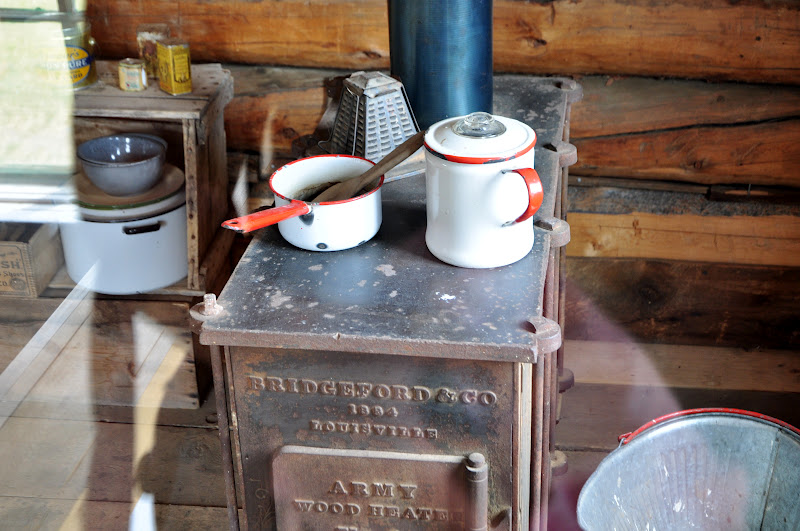
(A one-room cabin kitchen at the South Pass City museum)


4.  Regularly de-clutter the house.  I do this every few months and yet we still have toys everywhere and too many clothes.  After a crazy mouse went through our house two weeks ago and pooped on EVERYTHING, I realized how much more I could simplify.  In our simple, already-decluttered home, I managed to find an entire van load of stuff we could take to the thrift store.  And after doing 35+ loads of laundry to wash what the mouse had pooped on in every closet, in every room, I adopted my friend Amanda's system of only having 5-7 outfits per kid.  Now I'm forced to do laundry more often and I don't have 10 loads of clean laundry sitting on the laundry room table waiting to be folded.  Now all of the kids' clothing has to fit in a sealed rubber tub (lest we get another mouse in the house-yuck!) and has to be washed more often.  I do a BIG de-cluttering of junk before each new school year too.  This helps me feel better about my house before I begin the season of house-neglecting, AKA homeschooling.  The less you have, the less you have to take care of.  We all have stuff we don't need, taking up unnecessary space and causing us stress when someone else could put that stuff to use.  Get rid of it and save yourself the work of maintaining it!


5.  Establish a support network.  Whether it's online (love, love, love the My Father's World fb pages and all the collaboration that goes on there!), a local group, or just a close friend or neighbor who homeschools, find someone you can talk to, vent to, and pray with.  You're going to need it!  It's priceless to have people you can bounce ideas and questions off of ("Which Latin curriculum have you found to be easiest for young children?") and people to assure you that you aren't crazy for feeling the way you do after a long week of homeschooling.  I don't have a lot of homeschooling friends in my town, but the ones I do have are solid gold!  They are such an encouragement when I'm questioning why I've chosen this crazy, busy, challenging lifestyle!  Girl time is a must and should be a priority on your schedule.  It's a must for all moms, but I think it is especially important for the moms who never get a break from their kids.  So, make time for connecting with friends!


6.  Rest in God's grace for your imperfections and be humble.  Know you need His strength to do this each and every day.  It's easy to fall under the burden of belief that homeschooling families have to prove something to the world and to the naysayers or that they should be perfect.  This isn't true!  THERE ARE NO PERFECT FAMILIES.  No matter how perfect they look on the outside, they are still made up of sinners.  We all need the Gospel, not just once-in-a-lifetime, but every day.  It's also tempting for homeschooling families to be prideful.  Don't be quick to jump on a soapbox or judge those around you.  That curriculum you said you'd NEVER use?  You'll probably be using it in 3 years!  You think your kid is a genius?  The neighbor kid from up the street who goes to public school may come over and blow your kid away with how many math facts she knows.  Always talking smack about public schools?  Someday you may find yourself with a best friend who is a public school teacher or your child may need to go to public school for one of a variety of reasons. 

You will have days you will snap and yell at the kids.
The kids will fight...often.  The more kids you have, the more fights there will be
You will feel like the worst teacher in the world some days.
You will wonder if you have what it takes to keep going.
Some days you won't even like your kids.
You will be tempted to flag down the school bus going past your house.
You will be in a fierce spiritual battle for your kids (just like any Christian parent).

But take heart, friend, because God is with you in this!  You aren't alone and He wants you to trust Him in this walk of faith.


7.  Create a window of unavailability for yourself.  If you are a social butterfly, have a part-time job, or have a lot of ministry going on, you will need to carve time out of your schedule specifically for homeschooling.  Let your friends know you won't be answering the phone in the mornings (or whenever you do school).  Let online time (surfing, shopping, fb, twitter, e-mail, games, blogging, reading, etc.) be a reward for you at recess time or when the kids have finished their schoolwork for the day.  (Preaching to myself here--that's an area I need to work on!)


A.  Don't answer your phone or texts when you are in the middle of school.  We've even made an answering message that explains to people that school is in session and lets them know when we will be available.  If you help with a family business or need to be available for your husband that's fine, but try not to let your school time get eaten up by phone calls.  Caller ID is wonderful!


B.  Pare down your activities.  Before you begin homeschooling and during the summertime, it can be easy to fill your days with playdates, swimming lessons, library visits, nature walks, etc.  Once you commit to homeschool, you will have to let a lot of those things go or choose to do them after school is done.  Instead of continuing on with life as usual, you will need to keep "School Time" central to your day, or it won't happen at all.  Life, with all of its' urgent demands, will crowd out your schooling time in a hurry.


8.  Take care of yourself.  Every mom struggles to find time for herself, but when you homeschool it can be even harder because your day and your schedule revolves around their lessons/projects/needs, etc. 


A.  Make sure you are getting good nutrients.  My friend Nicci's vitamin smoothie is a daily must for me!  If you don't do smoothies, try these wonderful vitamins, available in a cheaper form here.


B.  Rise before the rest of the household.  My goal for this school year is to get up before the kids so that I have some quiet and some prayer time with God before tackling the busy day.  It's hard, but soooooo worth it.  Crystal is so motivating in this area!


C.  Always be reading a few good books.  Karen Andreola talks about this in her chapter on Mother Culture in her book A Charlotte Mason Companion.  Read things that stretch you, inspire you, delight you!  Model a love of learning for your children.  Don't get in a rut of only reading fiction or only reading personal growth books.  Read from a variety of genres.


D.  Have a daily quiet hour and enforce it.  Kids need boundaries.  When they are home all day with mom, it can be easy for them to fall into a "Mom is always at my every beck and call" mode.  They need to know that at certain times they are not allowed to seek Mom's help and attention.  We have FOB time in our home (taken from my days as a Camp Good News counselor--FOB stands for Flat On Bunk).  The kids can lay on their beds and look at books or sleep.  If they get off their beds or come upstairs they lose their afternoon snack;  something that is majorly important to my always-hungry kids.


E.  Plan for times of refreshment.  Take regular breaks.  Whether it's sneaking away to a coffee shop to think, pray, and plan on a Saturday morning, a daily jog around the block, or a yearly getaway with your husband, try to plan refreshment and rest into your week/month/year.  One of my goals for 2012 has to be to make Sunday more of a Sabbath in our home.


F.  Diet and exercise.  Of course we all know that we should be eating right and exercising regularly.  But how many of us can actually find the time to do so?  I've never enjoyed exercise, but I know my body needs it, so I find ways to be more active in my busy homeschooling schedule.  Instead of driving to a store or a friends' home, I will bike and pull the 2 or 3 little kids in the bike cart.  Nature walks are part of our curriculum and they get us all out into the fresh air.  Playing a game of tag with the kids, going for a hike, or swimming at the pool or lake are other things I enjoy.  Bountiful Baskets, a produce food co-op, has enabled us financially to eat much more produce. 


9.  Put together some activities to occupy little ones.  If you have babies or toddlers, it can be a challenge to keep them happy and out of trouble during school time.  Here is a great article on things to do with toddlers/preschoolers to keep them busy.  Here's a post I wrote a few years ago about our activity tubs.  A friend gave me a booster seat for the homeschool area and this has been the biggest help in keeping my own little tot, Katri, busy during our school time.  She loves to color and sit in her seat and "be a big girl."


A.  School while they sleep!  If you have a very demanding baby, try to do school during baby's naptime.


B.  Have a playpen in the living room where the baby/tot can safely play with toys while you do lessons with the kids.


C.  Fill a box with special toys that they can only play with during school time.  They can sit at your feet, or even on your lap, and play while you teach the big kids.


D.  Have one of the bigger kids take turns playing with the baby/toddler while you work with the other kids and then switch off.


E.  Wait until Daddy's home.  Do the more challenging subjects with your child early in the morning or in the evening when Daddy is home to hold the baby or occupy the tot.


10.  Abide in the Lord and seek His guidance regarding your priorities, schedule, and friendships.  This is the most important tip of all!  My friend Nicci is such a wise example of doing this.  You have to recognize you are just one person and you can't do everything people want you to do or be close to everyone in your life.  This is a tough one for me because God has brought a lot of young women into my life who need encouragement, friendship, and discipleship.  There are countless ministry opportunities available in my church and community.  I could try to grow my photography business if I wanted to.   Nicci always reminds me that just because I'm interested or have a talent or gifting in a certain area doesn't mean I am called to that ministry/vocation right now.  I am called to be a godly wife and mother, and frankly, that takes a LOT of my energy and time.  It's hard to know which friendships to pour into, which is why it needs to be a matter of much prayer.


Homeschooling is so rewarding in the end!  You can do it! 
May the Lord strengthen you and uplift you as you trust in Him for your children and your school year!


Pin It
Pin It
Pin It